I. Introduction
Today we're covering one of the most important aspects of financial markets: psychology and psychological behaviours. You can be a superb analyst or a wonderful technical trader but without a deep understanding of psychological concepts involved in financial markets, you will not get far. Psychology probably covers 80% of the market composition, as charts are a visual representation of humans' emotions.
Greed, fear, expectations, and euphoria are all factors that contribute to the markets' overall psychology. "Risk-on" and Risk-off" periods can be indeed identified by simply analyzing those feelings. "Simple?". Yes, conceptually speaking. Pity that once you get truly involved with your money things change, a lot. This is something that happens to everyone, don't worry, it's totally natural. Let's therefore analyze the psychology involved.
II. Wall Street Cheat Sheet
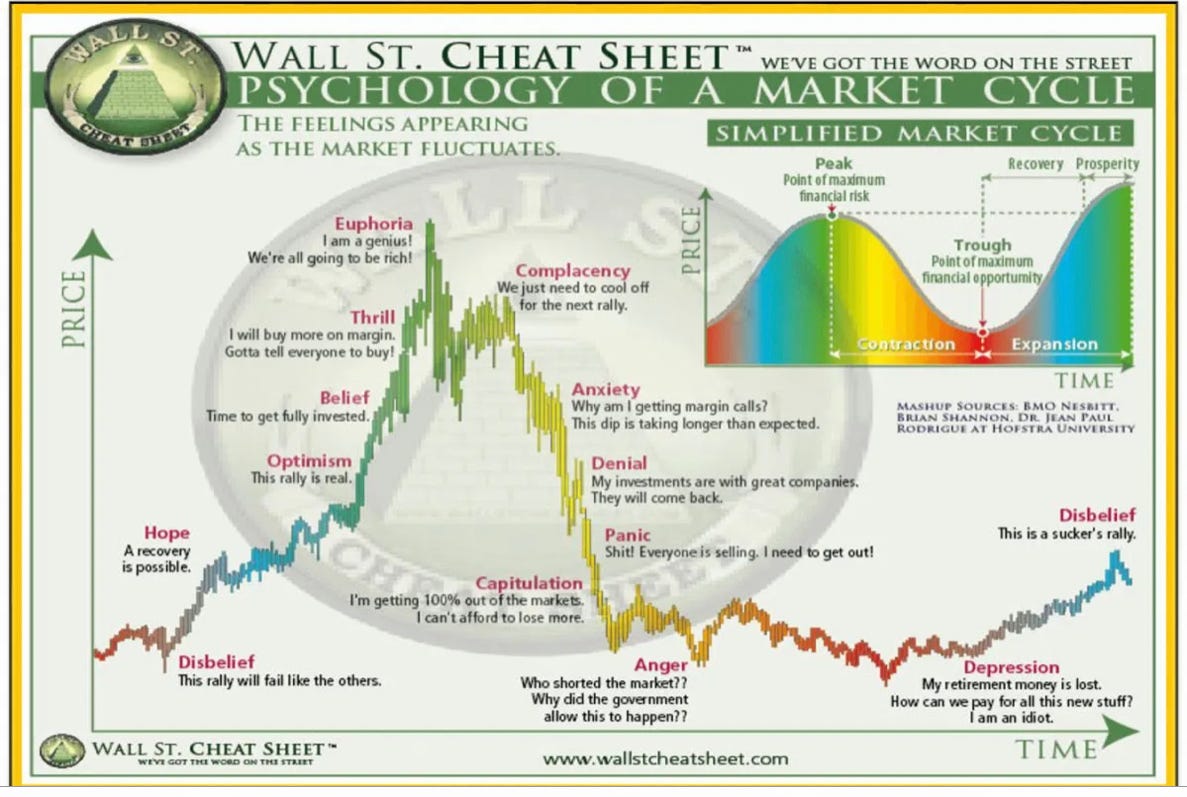
This is a famous chart that represents the feelings involved in a market cycle relative to its price action. Let's see what they're made of:
1. Disbelief:
Ever heard about "this is a sucker's rally” statement? The previous bear market condition has been deeply assimilated by mental attitude and when there’s an increase in the price of an asset, newcomers tend to play safe and remain sidelined while also remaining skeptical about the trend shift.
2. Hope:
Hope is the emotion that comes after the disbelief stage where most of the sidelined participants start to believe that a macro reversal is truly possible. 95% of them didn't prepare a plan and entrust their investments to hope, which sets the early ingredients for a financial disaster.
3. Optimism, belief and thrill:
These stages of the market start to become very dangerous. Prices are soaring fast and media attention (news, TV, advertisements) is becoming louder. Influencers and celebrities start to shill any sort of project without mentioning the risks involved. People are feeling the classic FOMO (Fear Of Missing Out) and start to swarm in like bees on the same flower. At some point, there is no more pollen to eat.
4. Euphoria:
The latest part of the cycle. During this time, prices skyrocket to new heights, attracting more compulsive buyers. Rationality has vanished, everyone is buying independently of the price of the asset as greed consumes the participants. Your non crypto neighbour and greengrocer start to talk about crypto. Everyone has heard at least one time the word Bitcoin. People flex their gains and start to think that they will become millionaires the day after.
5. Complacency:
This period is characterized by a moment of cooldown where prices push back and induce people to believe that is healthy, that the market needs to see a retracement before the next leg-up. This force them to hold their positions with the hope of another rally.
6. Anxiety and Denial:
The downtrend has already begun and anxiety starts to take place. Newcomers try to find out why this situation is happening searching for bias confirmations while continuing to hold their positions hoping for a reversal.
7. Panic and capitulation:
The market continues to fall despite the developments and the decline seems endless. People are in full panic and start to call the market a total scam, getting angry and selling at a loss. Assets seem devoid of any sort of fundamentals.
8. Anger and depression:
The latest part of the bear cycle. The prolonged downtrend has made people lose interest and label the asset class as a dead one. Retailers are now gone and they won't touch investments ever again. Or at least until the next hype will bring them back into the market. Smart people instead, start to look for opportunities.
- Important takeaway
There is always a narrative that forces people to believe that "this time is different". Narratives are one of the most powerful tools that market makers use to manipulate people's behavior and force to choose one way or another. This, most of the time translates into a big echo chamber where people start to hardly believe. Remember the Bitcoin S2F (stock to flow) ratio made by PlanB? Everyone believed that Bitcoin was 100% primed to go to 100k in December 2021.
"Bro, it will happen, the S2F model is perfect so I will go all in!"
Market makers used this big belief to sell and manipulate the market to their liking. Ever wondered why good news tends to come out like a tornado during bull markets and bad news instead comes out during bear markets? It’s something orchestrated to make sure that retailers join/do not join the market. Those who are seated above the herd always profit.
- Past example: Lebron James + Crypto.com at Super Bowl
"Fortune favours the brave" was the the slogan of Crypto.com advertisement made by Lebron James on the 13th of February 2022. The audience reached in the Superbowl has skyrocketed the downloads of crypto platforms.
That was the perfect move to induce retailers to buy crypto. "If Lebron James tells me that I need to buy crypto for changing my financial future it surely has to be true!" Knowing a Super Bowl spot costs $6.5m for 30 seconds all those crypto ads convinced an uneducated public to dive in, so the speculators could cash out. That marked the second and last leg up (complacency) of that cycle as you can see from the chart.

- Take note
Celebrities aren't your friends. They are paid millions to promote something that probably even don't know what and how it works. They don't care about me, you, and your neighbour. They only care about the money they receive from companies or big entities. Ask yourself: "who will profit from the sponsorship?" The sooner you'll realize it, the sooner you'll be ready not to fall into traps.
III. The news, a massive tool for herd control
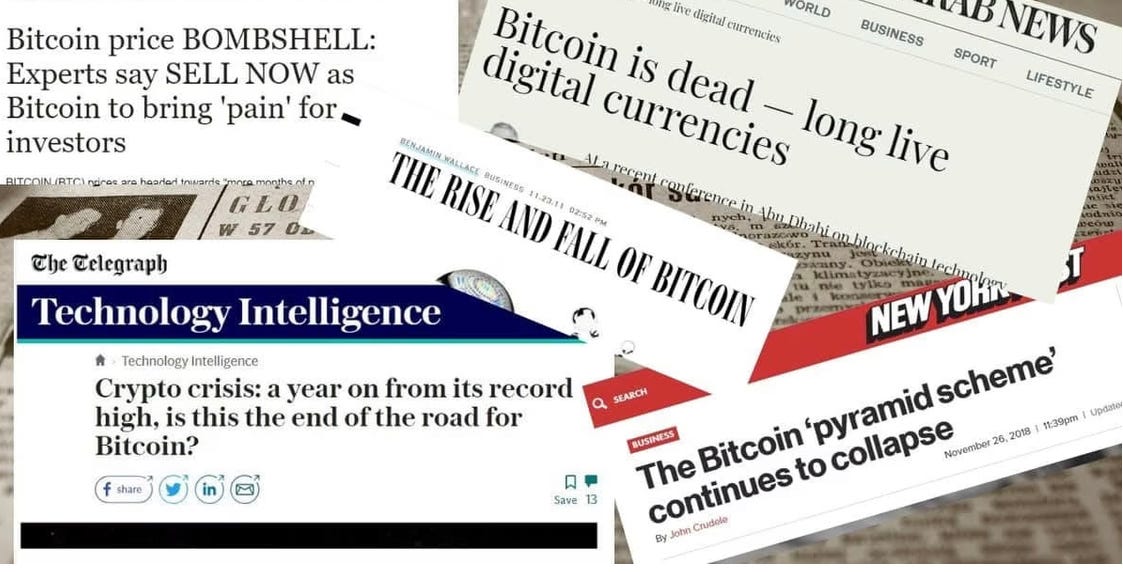
Every news has a very specific purpose, released from market makers to leverage people's emotions and profit from the situation. Is it a coincidence that Bitcoin is declared dead every time the price plunges to new lows?
If you think about it, the fundamentals are super solid. But the majority don't study so they only rely on premade news which, in those cases, makes them sell. On the contrary, Bitcoin becomes the supreme and perfect investment when the price skyrockets. Why? Because market makers want retailers to buy more so they'll have the liquidity to sell.
- Past example: 2020 Covid pandemic
This is an article from “Business & Finance” after the Covid pandemic drawdown that impacted the financial markets.
Read the paragraph at the top left: "Dow falls 10% on FEAR Coronavirus will paralyze global growth." People have sold their stocks and crypto and were sidelined due to FEAR, not because they were aware of the real risks.
2020 and the COVID-19 dump were the starting points of a massive bull run, after the FED quantitative easing. That's why it's important to contextualize every single news that comes out and understand the opportunities that it brings to us.
